Burt’s Bench: Meet Burt L., 3-Day Walker

There is a bench on Day 3 of the Dallas/Fort Worth 3-Day. It’s a beautiful bench, as far as benches go, with a shiny, smooth steel construction, and elegantly turned legs. It’s seated on a platform of river rocks, overlooking a fountain framed by trees. The hundreds of 3-Dayers who walk by this bench in Curtis Park may think it’s just a bench, but to 23-time participant Burt Lipshie it’s more than just a bench. This bench is the last place he talked to his cousin before she died of breast cancer.

race_3017_photo_48476956

Burt’s cousin Judy is “my dearest, sweetest cousin in the whole world. Breast cancer killed her in 2004.”

It seems like a twist of fate brought Burt to the 3-Day. “A month or so after she died, I’m sitting in my office in New York, and Judy is everywhere. She’s just everywhere. It’s a hard thing to describe.”

Burt sent an email to Judy’s daughters, saying, “I don’t know what’s going on, but I’m having a Judy day today.” They wrote back and said they were not surprised, because they were, too. Why were they having a “Judy day,” other than dearly missing their mom?

Their answer to him: “We think our mom is proud of us because we just signed up to walk the 3-Day.”

Burt knew immediately that he would support the 3-Day. “I told them that I would donate… and I thought about it for two days. And then, I thought, no. They can’t do this without me. I’m going to do it too.”

Just two days later, Burt was signed up for his first ever 3-Day. “I had to find some way to fight back. This is the most meaningful way to fight back.”

race_3017_photo_48476783

There was just one slight problem – the girls had already named their team “Juju’s Girls.”

“We changed the name to ‘Jujus Girls (And boy).’ We walked San Diego that year and I haven’t stopped. This is walk 23.”

What was this special woman like? Judy was “feisty.” Burt refused to tell her age, joking that he could hear Judy from heaven exclaiming, “Burt! What?! You’re telling my age?” She was the type of woman who was dying of breast cancer, but still taking care of her 91-year-old mother. Judy lived in Dallas most of her life, so Burt had plans to meet Judy at the Dallas/Fort Worth 3-Day. But by then, she was too sick to do it.

Towards the very end of the 60-mile route, Burt took a break from walking. “I’m sitting on the bench and I called to see how she was doing, and we talked for about five minutes. An hour later I got the call.”

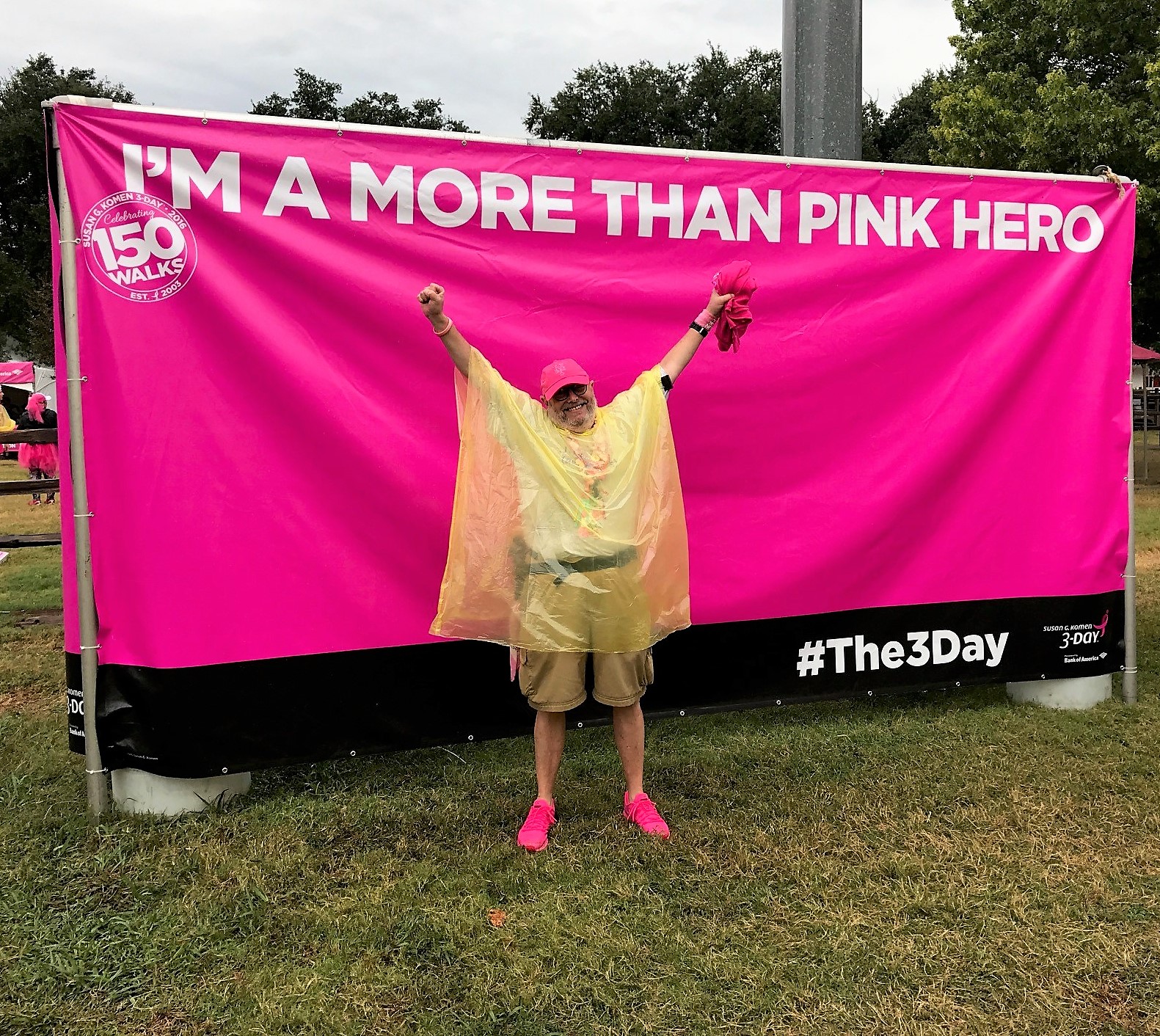
To Burt, the bench in Curtis Park isn’t just a bench. It’s a tangible memory, a place that marks the devastation of this disease. It’s a place he visits every year before he walks sixty miles in the Dallas/Fort Worth 3-Day, an event that he’s raised more than $208,000 for. It’s a staggering sum that has no doubt helped countless men and women fighting breast cancer. By now, Burt is well-loved by all his fellow walkers and member of the 3-Day Crew. As Burt walks in his neon pink shoes and pink Yankees hat, walkers call out to him, “My man!” slapping high fives and posing for pictures.

burt2

The bench is symbolic to all of us, because many places in the world become like Burt’s bench, marking the last place and time you talked to somebody you love.

When Burt comes to the Dallas/Fort Worth 3-Day, “It’s the first thing I do. I walk up Turtle Creek and I go up to the bench. And I sit on the bench for a little while, and I cry a little bit. And then I come back.”

Burt comes back because in this fight against breast cancer, you must always come back. You may be angry and grieving and devastated, but you must come back. Because, together, when we return to this fight, we are holding steadfast in our promise that we will never give up. And one day, Burt will sit on his bench and know that thanks to him and the help of people like you, more people like Judy will be saved.

burt-2

Where We’ve Been – A Collection of the 2014 3-Day Journey Maps

  • You’ve signed up for your very first Susan G. Komen 3-Day® and are anxious to know where the route will take you.
  • You’ve walked in the Komen 3-Day before, but are venturing to a new location this year and are curious to see how the route in the new city compares to the ones you’ve done before.
  • You and your team know you’re going to walk in a 2015 3-Day® event but you can’t decide which one, and you want to compare the possible options.

If you fit any of these scenarios, then feast your eyes below at the Journey Maps from all seven of last year’s 3-Day events. These maps will give you a good basic overview of where the route took walkers in each location last year, including the Opening Ceremony, Closing Ceremony and camp locations.

Please remember that these are Journey Maps from the 2014 3-Day Series, and are meant to be informational overviews only, not a guarantee of where the 2015 3-Day route will take you. As we explained in our Insider’s Peek at the 3-Day Route, things can and do change from year to year. The 2015 routes in each 3-Day location are still being finalized, and maps for each 2015 3-Day event will be emailed to registered participants the week of the event.

SUsan g. komen 3-Day breast cancer walk blog 60 miles map michiganSUsan g. komen 3-Day breast cancer walk blog 60 miles map twin citiesSUsan g. komen 3-Day breast cancer walk blog 60 miles map philadelphiaSUsan g. komen 3-Day breast cancer walk blog 60 miles map seattle SUsan g. komen 3-Day breast cancer walk blog 60 miles map atlantaSUsan g. komen 3-Day breast cancer walk blog 60 miles map dallas fort worthSUsan g. komen 3-Day breast cancer walk blog 60 miles map

dosomethinghuge_50OffApril6_v02

“She might not get a miracle, but she could be a miracle for someone else.”

Warning: this story may make you cry.

It will make you sad. It should make you angry. It should fill you with frustration and grief, as it did me when I met Lisa L. on the Dallas/Fort Worth 3-Day, then sat down to speak with her at length.

Lisa and her friend Brittney walk as part of team “Sasha 26.” Sasha is Lisa’s daughter. 26 is how old she was when she was taken by breast cancer.

susan g. komen 3-Day breast cancer walk 60 miles blog sasha lehocky

Brittney (left) and Lisa (right), representing team Sasha 26

Hearing Lisa recount the particulars of Sasha’s breast cancer journey—diagnosed Stage III at 23 years old after months of needless run-around and delays (as is often the case because she was so young, Sasha’s lump was dismissed and an initial mammogram denied); a rapid spread of the disease to her lymph nodes and lungs; surgeries and multiple chemotherapies—it’s unmistakable how closely Lisa was involved in everything that happened during the three years between 2010 and 2013. She sounds like a medical journal, the way she details specifics about the different diagnoses, tests, medications and procedures, but it’s the passion and indignation in her voice that can only come from a mother, especially when the news was as bad as it could be.

“She went from a clean bill of health to, you have 4-12 months to live.” Sasha’s cancer had metastasized into a rare form that was extremely difficult to treat, and extremely painful for Sasha. “It’s devastating to think you’ve won this battle only to be knocked down again…” The pain was real for Lisa too, being a mother whose daughter was, in many ways, forsaken by much of the medical community and ultimately was taken too soon.

I wanted to know more. I wanted to learn what would bring a mother to an event like the 3-Day. As Lisa told me, “The 3-Day is a huge thing for the community itself, but I’m still grieving for my daughter, and to be totally honest, I don’t feel like celebrating breast cancer. My daughter’s not a survivor. I’m a mom who fought for my daughter to live, and it’s hard to be part of the whole excited part.”

It’s completely understandable. With two daughters of my own, I could not imagine the grief and agony of losing a child. But here Lisa is, moving forward, about to tackle the final 4 miles of the route on blistered feet.

She is quick to point out that “Walking wasn’t my idea.” Lisa and Brittney are both Air Force Reserve officers in Texas (Sasha was also enlisted in the Air Force). “My unit has been so supportive of me with my daughter going through breast cancer and passing away. My unit just rallied around me. It’s a big unit, there are 250 of us, but Brittany had heard of Sasha’s story, and when I returned to the unit after Sasha had passed, she came up to me and told me that she was going to walk in Sasha’s name.” Brittney smiles subtly and sits quietly as Lisa continues. “I asked her who she was going to walk with. I mean, you don’t walk 20 miles a day, times three, alone. So I asked her who she was walking with, and she said, ‘By myself,’ and I thought, I just can’t let her do that. She’s doing this for my daughter. I need to be with her, to do it also, to help carry my daughter’s name for 60 miles.”

susan g. komen 3-Day breast cancer walk 60 miles blog sasha lehocky

Lisa has her beautiful daughter’s image tattooed on her arm

So Lisa signed up. She and Brittney went quickly from being acquaintances to teammates, and got to training and fundraising. “We raised money through all kinds of ways—through our unit, through our families, churches, neighborhoods.”

Brittney had her own connections to breast cancer as well. “I have three breast cancer survivors in my family. I know not everyone is as fortunate. I have these three women in my life today, so I realize how blessed I am to have them, because they could just as easily not be here. I’m really grateful that they’re here. There are plenty out there who don’t have that opportunity. They don’t have that chance.”

Lisa and Brittney’s friendship, cemented by this shared experience, is evident. Brittney laughs, “Yeah, there’s no turning back now! We can’t just see each other after this and go, ‘Oh, we only walked 60 miles together, no biggie!’ There’s no going back after that.” Lisa adds, “I have a deep respect for Brittney. She was going to do this by herself. She was inspired by the women that survived, and inspired by a young woman that didn’t. That, I think, proves a lot about her character and her spirit. I respect her for doing all that.”

I asked Lisa what Sasha would have thought about her doing the 3-Day. “Sasha would’ve been right here with me, and not once would she have complained about her blisters,” she answered with a chuckle. “Sasha was pretty tough. She never complained. Never complained, never said a harsh word, and she smiled throughout the whole thing. People would ask her, ‘Sasha, how are you?’ and she would answer, ‘Very well, thank you. How are you?’ And I would think, you’re not well! But she immediately asked about them instead. She was a beautiful soul, and I’m very proud of her. It’s funny, because I used to try and make her into a ‘mini me,’ now I’m trying to be like her!” I think that’s really beautiful.

“I’m trying to be like my daughter now. Like I said, she fought this disease, and she asked the doctors not to give up on her. Dr. Santosh Kesari [a San Diego-based neuro-oncologist] never did. He never gave her a time limit. And I think that’s what helped. That’s why she lived for 19 months, instead of the 4-12 months the other doctors gave her. He never put a time stamp on her.” To have finally found doctors willing to take on Sasha’s aggressive case was a big step, even if it came late. “They tried some things that other doctors wouldn’t try, and they slowed down the cancer. And now they’re doing it for other patients. On tumor boards, they still talk about Sasha today. From all the procedures and the chemos they tried on her, they were able to extrapolate what happens to the body when they go through these procedures. What happens to the cancer.”

“Sasha surprised everyone. She amazed everyone. Every time she walked through the door, they were just amazed by this young woman. Her strength, her courage, her grace.”

I asked Lisa what she would take away from the 3-Day experience. “I will always cry for just me and my daughter, but from here, I take away the bigger community, the bigger aspect of what breast cancer does to other lives as well. Because for me, it’s just my daughter. But I know other people get cancer, I know that. It’s invasive. It knocks everybody for a loop. But yet, it just brings everybody together too. They stand up and say, ‘Let’s get on with this!’ There’s a bigger camaraderie here, and so much more. You’re able to honor people.

“I knew it was a fundraising event, but actually, it’s more than that. I think these women come for bonding moments, they come for support, they come because they don’t want their daughters to have breast cancer. There was a lady we met on the trail who was walking by herself. We asked her why she was walking, and she said, ‘I just wanted to.’ She couldn’t get anybody to commit to do it with her, but she did. She just did it! That’s pretty remarkable. You meet special people, because it takes someone special to do this.”

We’re interrupted by a woman who politely asked, “Excuse me, are you walkers?” Lisa and Brittney acknowledged that they were, and the woman thanked them for walking. She was visiting Dallas, and had no idea the 3-Day was in town. She was an 8-year survivor who happened to find herself in the same park as our Day 3 lunch stop. It was a brief, 20-second exchange, and when she walked away, Lisa looked at me and said, “It’s moments like that.”

Brittany, meanwhile, had been sitting quietly, listening to Lisa’s story with the attentiveness and respect of someone who hadn’t heard it many times already. I asked her what she would take away from the 3-Day. “The camaraderie. People who gave their time to come out and support you. Just little things. Handing you a bottle of water. We saw one house that just had a pink polo shirt hanging outside. Just little things like that, just saying hey, we know what you’re doing and we appreciate it. That camaraderie is amazing.”

I asked, “It may be too soon to think about this, but do you think you’ll do it again?” Lisa laughed again (a nice sound), and said “I think once my blisters are healed and I’ve forgotten the pain! We’ll definitely do it again. We will. And maybe we can get a bigger group together, because now we kind of know the ropes. I think with our experience, we might be able to recruit more people next year.” Brittney added, “It’s a challenge, it is. But it’s well worth it. Because we can. That’s the big thing. I’m still here to walk, so why not?”

Lisa went on, “I just admire every person that comes out here. Women and men of all ages. What is inspiring is that they know they’re going to hurt. They already know. They know it’s going to be rough and be a trial, but they’re going to do it anyway. They do it over and over again, they keep plugging away at it until it’s something that—until breast cancer isn’t a death sentence to some of us.”

I ended our conversation by expressing my gratitude to Lisa for sharing her story. I told her that I know that this has probably been a really difficult weekend for her in a lot of ways, and, I hope, a good one in a lot of other ways. Her willingness to share was so important, because I think a lot of people need to hear that the story doesn’t end as well for some.

But I told Lisa her story’s not over. She replied, “Sasha did a lot for the medical community. She did a lot for teaching her mom a few lessons, and I think she taught others. Sasha said to me that she might not get a miracle, but she could be a miracle for someone else.”

I think that’s pretty clear.