Six Things to Remember When an Injury Interrupts Your Training

Around this time of year, the air is getting warmer, the days are getting longer, and the natural result of these changes is that Susan G. Komen 3-Day® walkers are coming out of hibernation and diving into their Komen 3-Day training with vigor and enthusiasm.

So when an injury comes along—anything from shin splints to plantar fasciitis to back trouble—and takes you out of your 3-Day® training schedule, it can really hinder your momentum and leave you feeling frustrated. Keep reading for some advice on what to do when an injury sidelines you in the training game:

Don’t ignore the problem – You feel something. Maybe just a little twinge in your hip, or a dull throb on the bottom of your foot. And many of you (like me) will think, “It’s nothing, I can walk through it.” In some cases, it will be nothing, but if you start to feel something that just isn’t right, don’t ignore it. Be diligent about stretching, use ice and/or ibuprofen for the problem areas, and if those extra measures don’t work, don’t delay in seeing a doctor. A little bit of extra caution now will pay dividends when you’re healthy and whole for the 3-Day.susan g. komen 3-Day breast cancer walk blog training injury
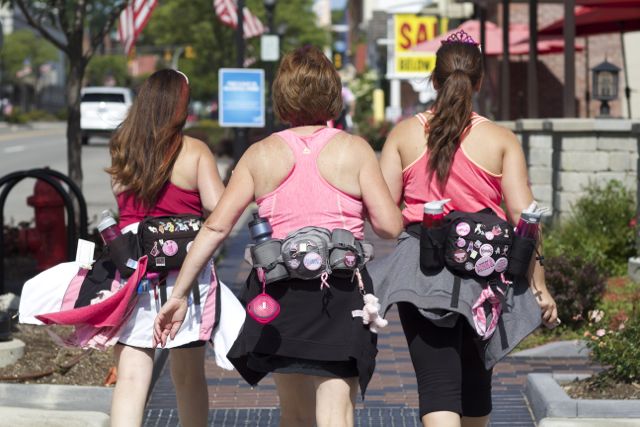
Keep in mind why you’re here – The 3-Day is an inspiring and challenging athletic endeavor (let’s face it; walking 60 miles in 3 days is physically way beyond what most people would attempt), but the walking is only part of the reason why the 3-Day exists. The awareness that you’re creating, not to mention the fundraising you’re doing are making the real impact in the fight against breast cancer.susan g. komen 3-Day breast cancer walk blog training injury

Double down on fundraising – And speaking of fundraising, if you get hurt while training and have to take a break for a few days or even weeks, take heart in the fact that the money you’re raising can’t be affected by physical injury. Use your down time to send out another fundraising email or plan a fundraising event. If you’re feeling especially dramatic, you could even use the injury as a backdrop for a money-raising gimmick (“The doctor says I have to stay off my feet for 10 days; who will donate $20 for each day?”)

Cross train however you can – Even if you can’t walk, you don’t have to be still. Cross-training is a way to incorporate non-walking activities into your regimen, and there are all kinds of cross training tactics you can try while your injury heals. Swimming, for example, is a great option in the warming weather, and is particularly gentle on joints and muscles.

Don’t rush back – If you’re recovering from a walking-related ailment—particularly if it was something caused by overuse, or a traumatic injury—ease back into your training slowly. I know, you’re excited and eager to get back out there, but to reiterate what was said above, a little patience and restraint will benefit you greatly when you’re able to cross the finish line on Day 3 on your own two feet.susan g. komen 3-Day breast cancer walk blog training injury
60 miles is a goal, not a requirement – The frustrating truth is that sometimes injuries do get the best of us, and all the rest, stretching and patience in the world may not leave you equipped to walk 60 miles. That’s okay. Walking every step of those 60 miles should be your objective, but remember that it is in no way an obligation. You’ll get out there and walk as much or as little as you will, and we will be there to support you across every inch—whether you’re on foot, under the care of our outstanding medical crews, or carried the distance by the amazing bus and sweep teams.susan g. komen 3-Day breast cancer walk blog training injury
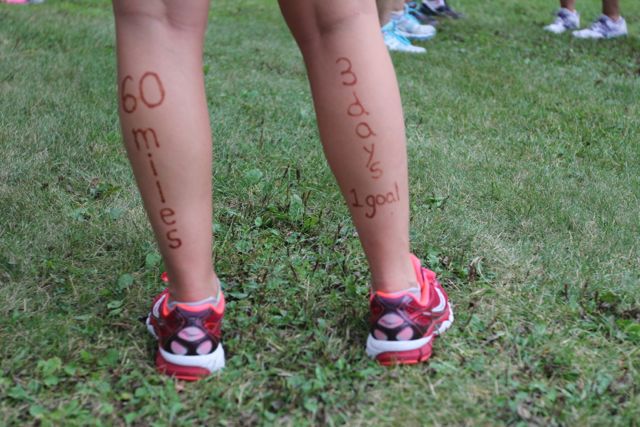
We’d love nothing more than for every one of our walkers to make it through their training completely unscathed, but if an injury does sneak through, we have no doubt that any one of you will weather the obstacle like the rock stars that you are.


PLEASE NOTE: THE HEALTH, SAFETY AND TRAINING INFORMATION PROVIDED TO YOU IN CONNECTION WITH YOUR PARTICIPATION IN THE SUSAN G. KOMEN 3-DAY IS NOT INTENDED TO REPLACE OR BE CONSTRUED AS MEDICAL ADVICE AND ANY SUCH INFORMATION IS NOT A SUBSTITUTE FOR SEEKING MEDICAL ADVICE OR TREATMENT FROM YOUR MEDICAL PROVIDER. BEFORE STARTING ANY EXERCISE PROGRAM OR FOLLOWING ANY RECOMMENDATIONS, ADVICE OR OTHER INSTRUCTIONS REGARDING TRAINING FOR THE KOMEN 3-DAY OR ANY ATHLETIC EVENT, YOU SHOULD FIRST CONSULT A PHYSICIAN AND HAVE A PHYSICAL EXAMINATION.
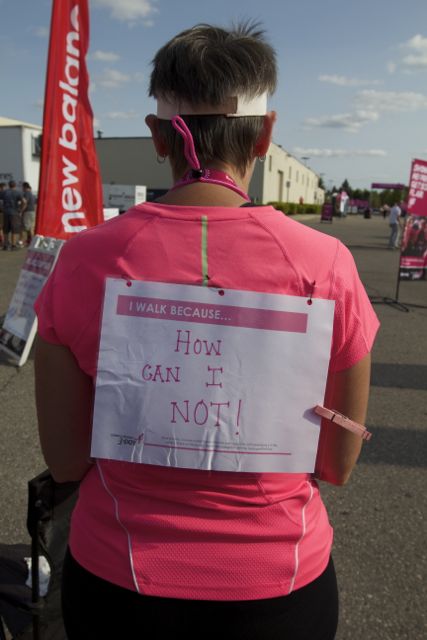
3 Reasons Why You Should Always Ask for a Specific Donation Amount

susan g komen 3-day breast cancer 60 miles walk blog specific donation amount fundraisingQuick poll: while fundraising for the Susan G. Komen 3-Day®, who among you has written a fundraising letter or email, posted a Facebook ask, or made an in-person request and used some version of the following statement: “Please donate whatever amount you’re comfortable with.”

It’s true that every donation made to the Komen 3-Day—no matter the amount—is important and will make an impact in the fight against breast cancer. But experience has shown us that asking your donors to give a specific amount is a more successful fundraising tactic than the “whatever you’re comfortable with” route. Here’s why:

An Unmistakable Call to Action – People like to be given directions. When you ask for 3-Day® donations in a specific amount, you give your donors a clear instruction to act on, which will make them more likely to donate right away. Putting a deadline on your request is another great way to motivate your donors to give without delay.susan g. komen 3-Day breast cancer walk blog fundraising donations

Aim High, Land High – For the past several years, I’ve straight-up asked my donors for $100 donations in my initial fundraising emails. I make no apologies for it, and I remind my donors that my job as a 3-Day walker, first and foremost, is to raise as much money as I can for Susan G. Komen®. I make this request knowing full well that many of my donors will not donate that much. But what I’m really doing is setting an expectation. Asking for a large amount says to my donors, “This is important, and your part in it is important.” Sometimes it works and I see those hundred dollar donations hit my account, but even if the donor is not willing or able to give that much, they will still end up giving as much as they can. On the other hand, back when I used to say, “Any amount is okay,” I found that donors would often give far less.susan g. komen 3-Day breast cancer walk blog fundraising donations

Attention-Grabbing Gimmicks Work – Last year, I sent out a fundraising email two weeks before my 37th birthday, challenging my supporters to help me raise 37 donations of $37 each before my big day. The amount I asked for was very specific, very manageable, and since the birthday angle tied to it was personal to me, it was highly appealing to my friends and family members. The response I got from donors was immediate and generous; I raised over $1300 in less than 2 weeks, based on this tactic alone. If I had thrown out a request that said, “Please make a donation in any amount in honor of my birthday” I can’t imagine the ploy would have been as successful. Click here to find some other fundraising strategies that incorporate specific donation amounts.

susan g. komen 3-Day breast cancer walk blog fundraising donations


The Insider’s Peek at the Michigan Route

In February of this year, we treated our readers to The Insider’s Peek at the 3-Day Route, where we gave you a detailed look at the planning, work and execution that goes into creating the routes for the Susan G. Komen 3-Day® events. While that two-part Insider’s Peek was full of tasty details, it was still kind of broad in the sense that it didn’t explicitly address the particulars of any specific Komen 3-Day location.

Until now!

It seemed like a natural progression to go from an expansive overview of 3-Day® route-planning in general, to a more pinpointed look at each of the seven 3-Day events individually. So I’ve been picking the brains of the event planning team and local coaches, to get the skinny on what walkers can expect. Sharing this information early in the year will help walkers prepare for their events, train for what’s to come and have a few exciting high points to look forward to.

We’ll do one of these for every 2015 3-Day event, in order, which means: you’re up, Michigan! Here’s what Event Planning Manager Missy and Local Events Coach Ann had to say:

  • Will there be any major changes to the route from last year? – Missy assured me that there will be “No major changes from 2014!” (Click to see the 2014 Michigan 3-Day Journey Map and the 2014 Michigan 3-Day Wrap-up.)susan g. komen 3-Day breast cancer walk blog 60 miles michigan route
  • What, if any, geographical challenges does the Michigan route present (i.e., Are there hills? Sections with no shade? Portions of the route that sweep vans can’t access easily?) – Missy’s response to this question was, “Although there is no extreme terrain in Michigan, there are plenty of motivating challenges when walking the 3-Day there, including some minor hills in the afternoon on Day 1 and a set of stairs after lunch.” Ann, a native of the Detroit metro area, confirmed, “Southeast Michigan is pretty flat compared to other 3-Day locales, but there are a couple hills that people should be sure to train for.” Missy added, “Day 2 has a challenging hill after lunch, and portions of the route are off-pavement.” Ann said, “Sweep access is pretty consistent, but there may be a few short stretches that don’t allow for easy access. We also walk a stretch of Hines Park on the afternoon of Day 2, which can be a bit on the shadeless side, depending on the time of day.” Missy’s concluding thoughts were, “On Day 3, walkers have little change in terrain, but go through more urban areas – some without shade.”susan g. komen 3-Day breast cancer walk blog 60 miles michigan route
  • Any specific highlights/locations that walkers can look forward to seeing along the way? From Ann, “Historic Downtown Plymouth (with the pink fountain) and Northville on Day 2 are always great areas with tremendous community support. On Day, 3 the residents of Dearborn love to come out to cheer and decorate their streets.”susan g. komen 3-Day breast cancer walk blog 60 miles michigan route
  • Any other information you can provide about the overall nature of the Michigan route? – Ann is happy to brag about her home state: “It’s a great mix of residential, commercial, and rural. The route goes through some of Detroit’s nicest suburban communities and folks are always really supportive.”susan g. komen 3-Day breast cancer walk blog 60 miles michigan route


The Bottom Line: Michigan walkers really don’t have much to worry about, as far as challenging terrain goes, but they should definitely work a few decent hills into their training, so nothing takes them by surprise. The Midwest in early August can get pretty hot and humid, and rain isn’t out of the question, so training in the heat to get used to it is a good idea too, as well as packing for the elements (but don’t worry about that until later). With those preparations locked down, walkers will have a beautiful and scenic route, with tons of community support greeting them in Michigan.

Still have questions about the Michigan 3-Day route? Call your Michigan 3-Day coach Jennifer at 800-996-3DAY (select option 4 for Michigan), or email michigancoaches@the3day.org.