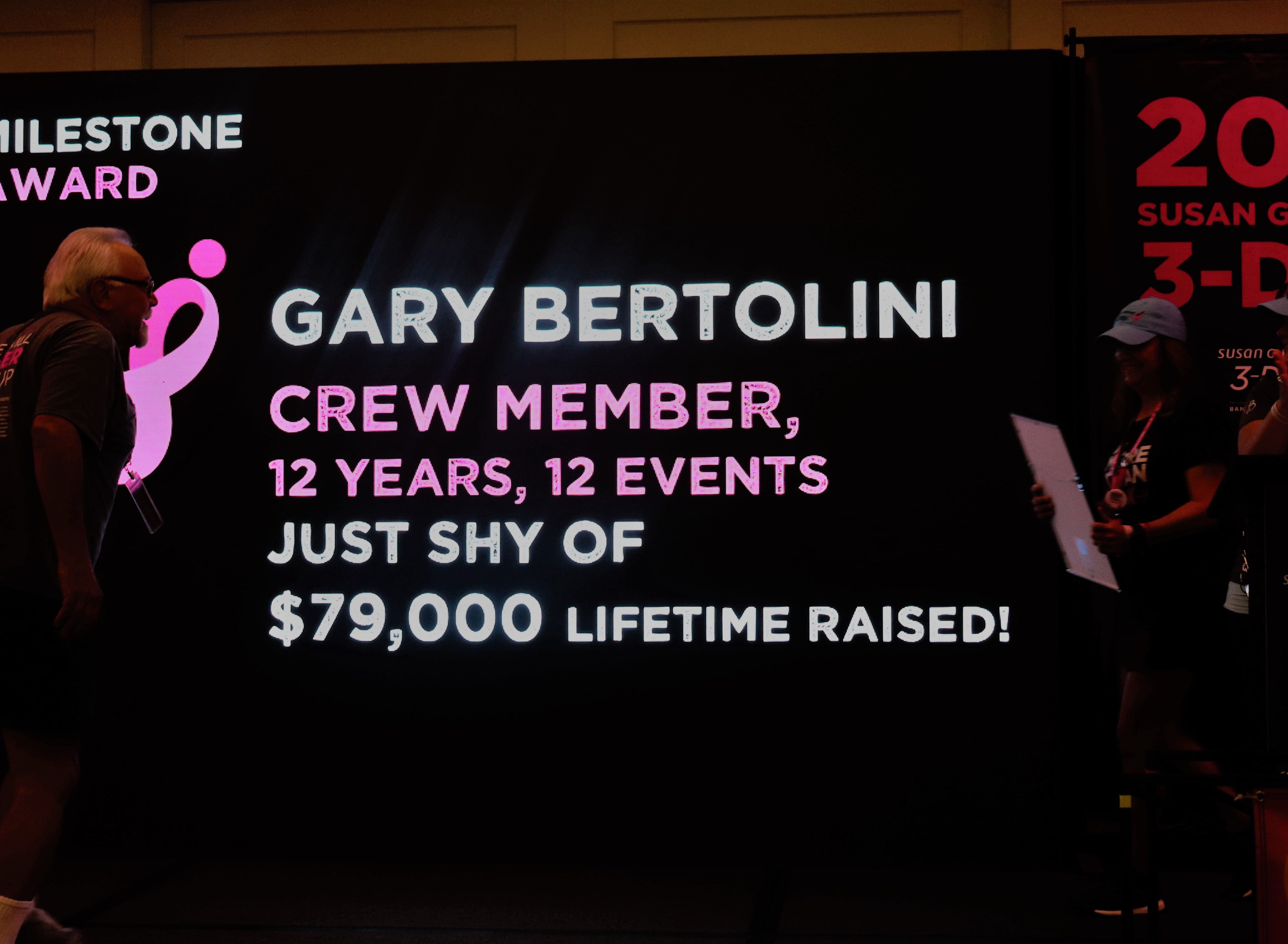
Please join us in congratulating our 2019 Milestone Award Winner; Gary Bertolini. The Susan G. Komen 3-Day® Milestone Award is given at each event to a walker or crew member who has an outstanding history of participation in the Komen 3-Day. At the Michigan 3-Day camp show, we presented Gary with this special honor.
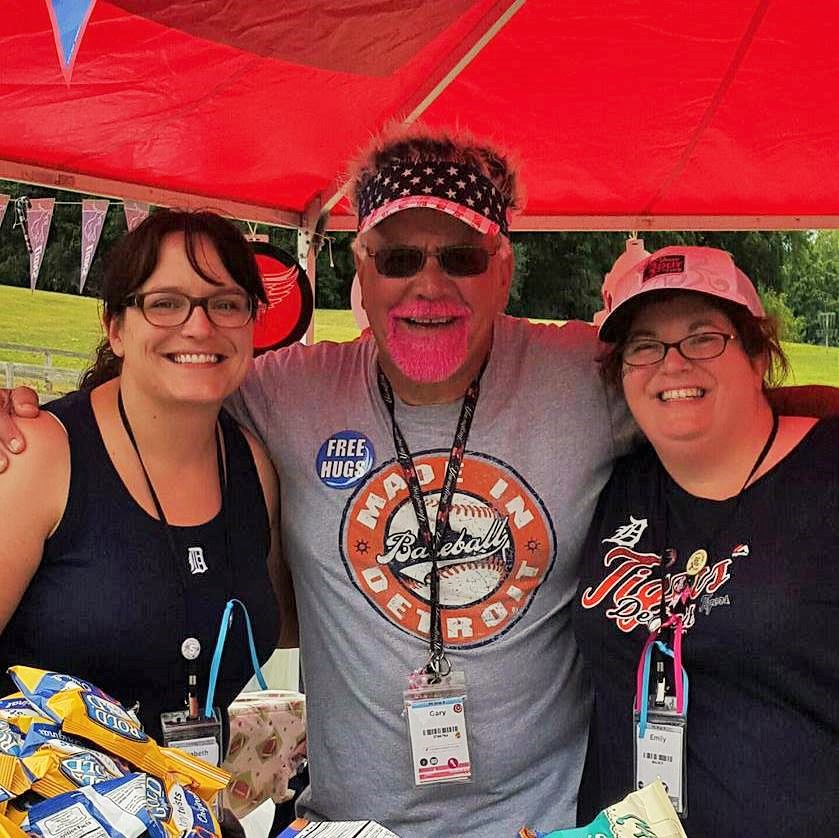
Gary is loved by both the 3-Day family, and his own family as well. He has managed to merge those to groups to surround himself with people who can’t say enough about him.
His son-in-law Tom Crews with Gary, and says,
If you’ve met Gary, you know that he bleeds pink for more than three days out of the year. The Michigan Komen 3-Day is not a week long event for him, but a commitment. His decade in the 3-Day aligns roughly with my entrance into his family. I remember stories of him walking the route the weeks ahead, and preparing it for walkers because that’s just what he does.
As he became more involved, we had conversations about ideas he had to increase membership and try to rejuvenate the Michigan 3-Day, and how excited he was to pass those ideas along. Three years ago, when Gary’s grand kids were old enough that we could leave them for a long weekend, I remember thinking he must have put something in the water to make me think this was a good idea, and I joined. It wasn’t in the water, it was in his passion to help others. It wasn’t good enough to raise money, he had to try to raise thousands of dollars every year! It wasn’t good enough to be on crew, Gary had to be a leader by example on that crew. He was the first one there ready to work and the last one to stop. As his son-in-law, the pressure was on, but in the best way possible. Gary’s commitment inspired me to do more than just thank him for the incredible work that he’s doing to ensure my daughter, his grand-daughter, will never have to be a survivor of this terrible illness, he inspired me to step up and be a part of the change.
Gary’s commitment to Komen, his passion for all the organization stands for, his tireless work ethic for the 3-Day weekend and the 362 days that lead up to it, and his selflessness to fight for the cure are just a few of the reasons that I’m proud to call him Dad and that have inspired me and others to get involved in this cause!”
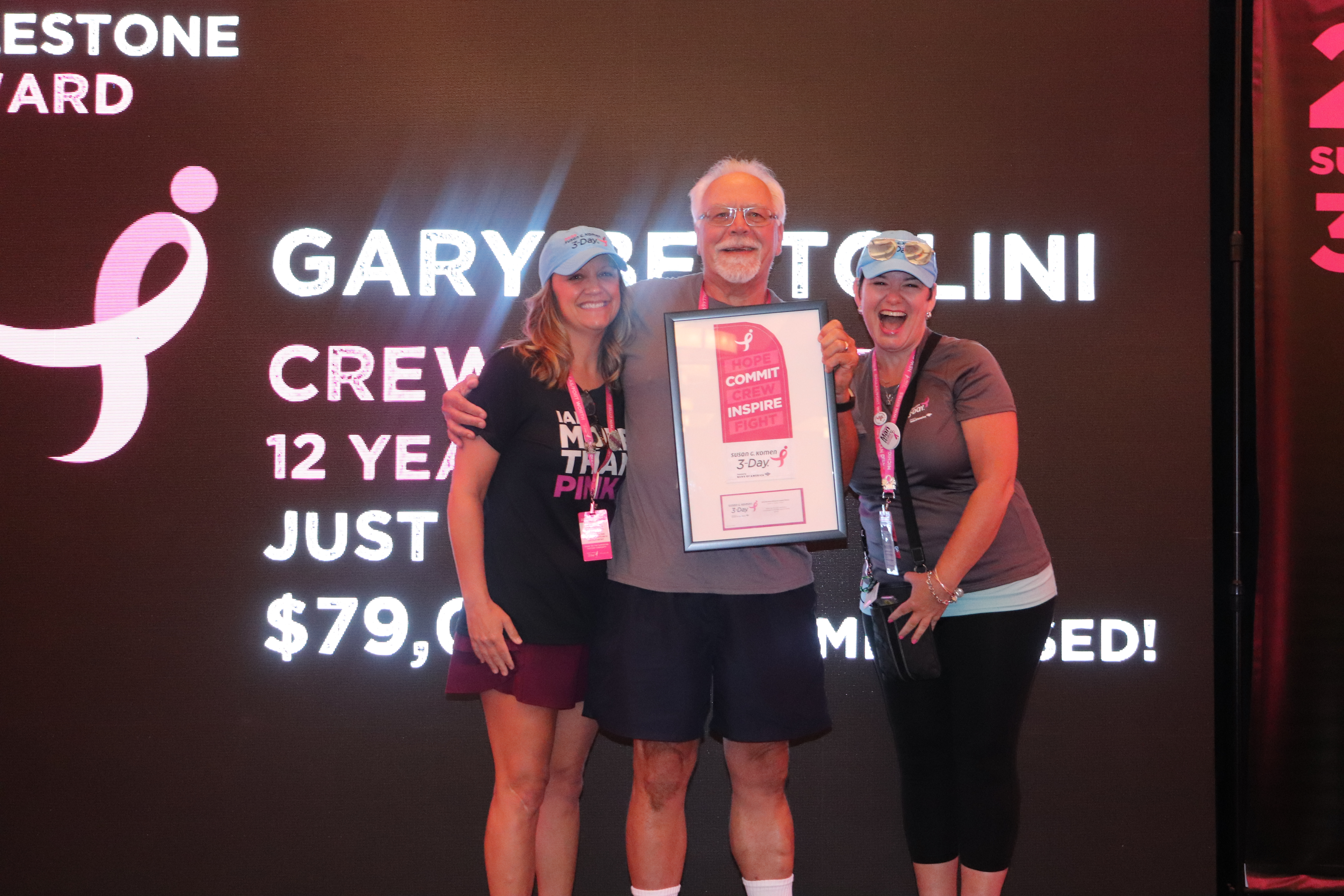
His daughter Liz L. also Crews with their family, and has seen the 3-Day grow and live in Gary’s heart for more than a decade.
“Over the past twelve years, the 3-Day has become a big part of my dad’s life. The first year, Gary chose to walk to honor friends and family members who had been affected by breast cancer. But, like many of us, after participating one year, he was hooked. He participated for several more years as a walker, raising much more than the minimum donation each year. As time passed, Gary became more involved in the 3-Day organization by participating on advisory panels and offering suggestions about how to grow the event.
A few years ago, Gary transitioned from a walker to a crew member, but did not lose his drive to make the event the best it could be. He continues to fundraise thousands of dollars each year as a crew member, and gives his all on event. Whether he’s driving a truck, setting up a shelter, restocking the food tent, or encouraging walkers, he’s there with a smile and a can-do attitude that keep everyone going. If Gary sees something that needs to be done, he will take care of it, no questions asked. For three days, he’s not just our dad, but everyone’s dad. If someone is struggling to open a case of water, he’s there with his pocketknife to help out. When he sees a walker struggling to make it into lunch, he offers them his camp chair or a fresh piece of cardboard to make them more comfortable. Gary always has a warm smile and is ready with a good dad joke to make people smile. And when friends and family come to visit and cheer the walkers on, he’s the first to welcome the little kids to the event as a temporary grandpa. I am so proud of the commitment Gary has made to the 3-Day event and to finding a cure for breast cancer. His positive attitude and hard work are truly an inspiration.”
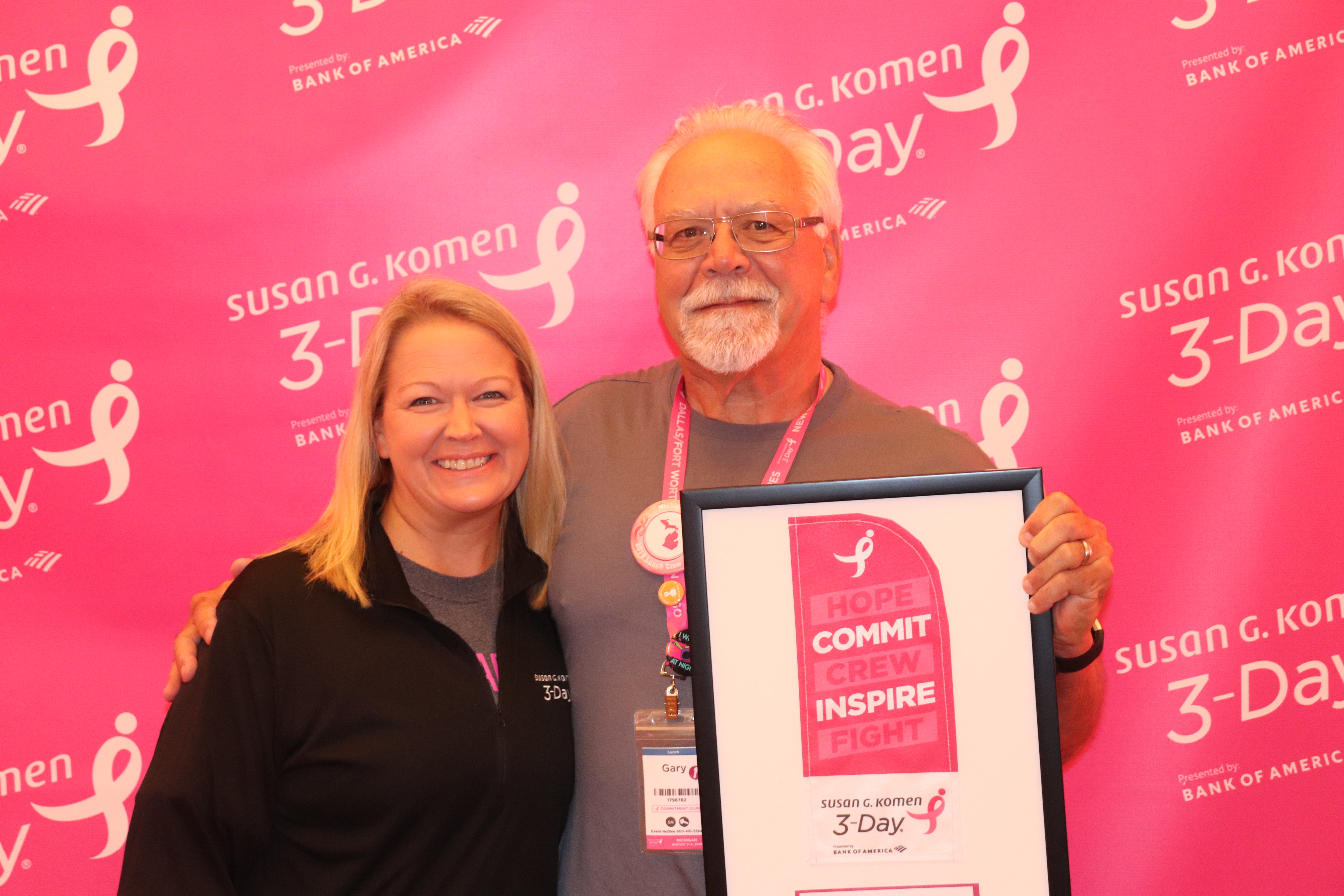
His other daughter (and fellow Crew member!) Emily, echoes that sentiment.
“In 2008 my dad asked my sisters and I which one of us wanted to walk 60 miles with him. Now, none of us are particularly athletic so we weren’t sure what he was thinking, but Dad filled us in. He wanted to participate in the Susan G Komen 3-Day in memory of his colleague Linda Dinger, who had recently lost her battle with breast cancer. Thinking of the family connection we also have – my grandmas both survived breast cancer – I agreed to be his buddy and tent-mate for what would become our first event. I was intimidated by the fundraising, but Dad told me not to worry; it turned out he was very right! That first event was both a learning and bonding experience, sharing a smaller space in a pink tent than we ever had, and Dad improvised some first aid techniques for a blister that definitely weren’t part of the training. We didn’t usually keep the same pace but we met up at lunch each day, even when I had to sweep there, and that really kept me going. By the time we crossed the finish line together, Dad was hooked on the experience and talking about things to do for the next time.
Dad continued to walk until a few years ago, with my Mom as his personal support team, smashing through the fundraising minimums every year. Even after joining me, my sister Liz, and later my brother-in-law Tom as crew, Dad continues to fundraise like a walker with his unwavering dedication to the cause. Dad had heart bypass surgery a few years ago, and I’m sure that all his walking kept him in good physical shape and helped his recovery. Even after his surgery, Dad has not missed a Michigan 3-Day event since we started.
I’m so proud of my Dad’s contributions to all aspects of the 3-Day, from motivating other walkers with “dad jokes” and a fart noise machine, to helping run a pit stop, to participating on the advisory council to his remarkable fundraising.”
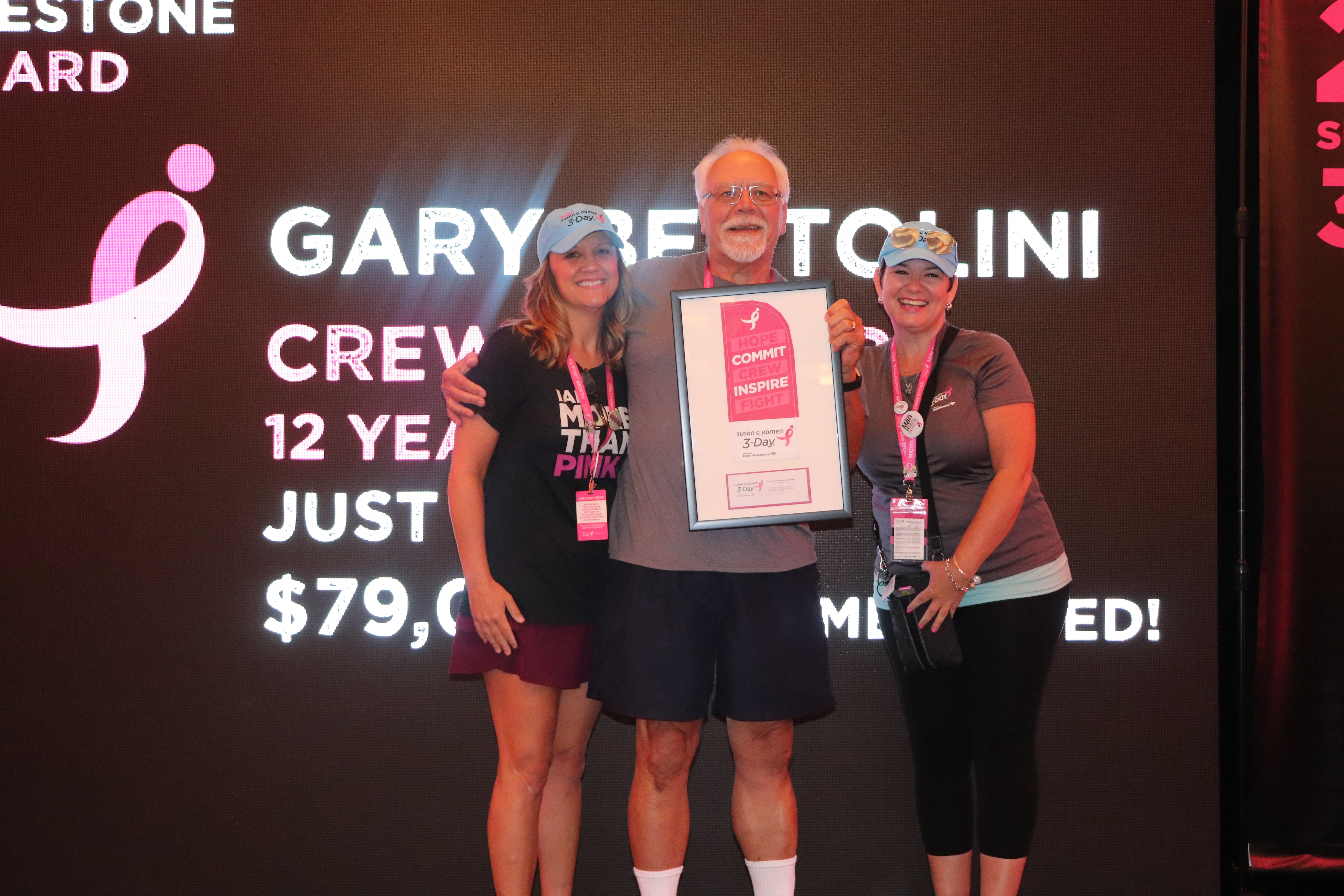
After all of that heartfelt praise and admiration, we had to speak with the man himself! This is the 3-Day, according to Gary.
What was your inspiration to do your first 3-Day?
A good friend and co-worker lost her hard fought battle with breast cancer in 2006. She was a young mother of 3 taken from us too soon by this disease. I decided to participate in the 3-Day to honor her memory.
What has brought you back year after year?
While we have made great progress over the last 12 years there is still a lot more to do. I hope to stay involved until we have a cure. Also, I do this to show my children that it is important to have causes and to give your time and energy to supporting them. Two of my daughters and my son-in-law participate with me each year.
What is the secret to your 3-Day fundraising success?
It starts with a great group of friends and family that know how important it is to find a cure so that future generations don’t have to experience this disease. It also helps to be doing this to honor a woman that was loved by so many. In addition to this I believe the secret to my success in persistence. I start with this long list of annual donors with a letter soliciting their continued support. Then I repeat it every month until I receive a donation. Not many have told me to stop because I am becoming annoying but many have thanked me for the reminder and said “I thought I had already donated”.
What is your best advice to anyone participating in the 3-Day?
Work hard to fundraise and train before the event. If it is your first 3-Day try to join a group of experienced 3 Dayers who can help you with training and fundraising tips. Once you are on event – Have Fun!! Reflect during the day on why you are here and engage with others along the route – share stories and make new friends!!
What is a fun fact about you?
I am a jokester. My kids and grand-kids moan and groan at my “Dad Jokes”. It gets so bad at times that I tell them something serious and they wait for the punchline!! I have to tell them I am not joking. Oh well, a small price to pay I suppose!!
What are the most important lessons you’ve learned on the 3-Day?
This event is ultimately about raising money for breast cancer research and programs that save lives. If you are on event you have done your job and you should feel very proud for doing so. This is not about causing yourself physical harm. Walking each step of the 60 miles is an accomplishment but not a requirement. You know your body and what it can do. Please don’t push it beyond your comfort level. All of your supporters want you to be healthy the day after the event. Tired but healthy!!
Congratulations, Gary!