Raising Awareness for Male Breast Cancer at the 3-Day

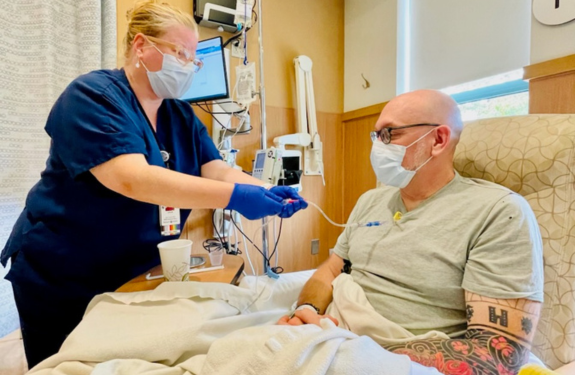
Jake Messier is living with metastatic breast cancer and is seen at chemotherapy.

Jake M.,54, is preparing to walk his first Susan G. Komen Boston 3-Day® with one goal in mind: to raise awareness that men can get breast cancer, too. 

In 2023, Jake discovered a lump in his armpit while putting on deodorant. 

“In the moment, I thought it was weird, but I went on with my day,” Jake said. “Guys aren’t taught that when we find a lump, we should tell somebody.” 

He didn’t mention it until a routine physical months later. 

“My primary care physician listed off about 10 things that it could be and none of them were breast cancer,” Jake recalled. “But I’m thankful he wanted to be ultra sure and sent me for an ultrasound and mammogram, and then that snowballed to a biopsy.” 

Jake was diagnosed with stage 2 breast cancer—but he believes it was likely more advanced. 
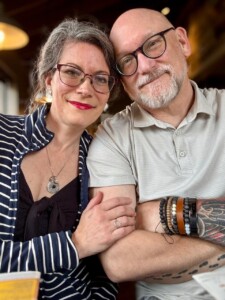
Jake Messier and his wife are preparing to walk in the Susan G. Komen Boston 3-Day.

“I know I was likely misdiagnosed stage 2 and was actually stage 3,” Jake explained. “Then about a year later when it traveled to my hip, that’s when it metastasized.” 

Since then, he has undergone chemotherapy, a mastectomy, two additional surgeries and 10 weeks of radiation therapy. He also recently spent six weeks in a wheelchair after a hip biopsy.  

From Diagnosis to Advocacy 

Over the last two and a half years, Jake has turned his metastatic breast cancer (MBC) diagnosis into a personal mission.  

“Breast cancer is still seen as the pink disease—a woman’s disease,” Jake said. “I’m hoping to try and change that through the advocacy I do and by walking in the Komen 3-Day.” 

Through his TikTok account @theguywithstage4breastcancer, Jake shares his story to raise awareness and remind men to listen to their bodies and speak up when something doesn’t seem right.  

If I can make an impact with whatever time I left have,” he said. “I want it to be this: men can get breast cancer.”  
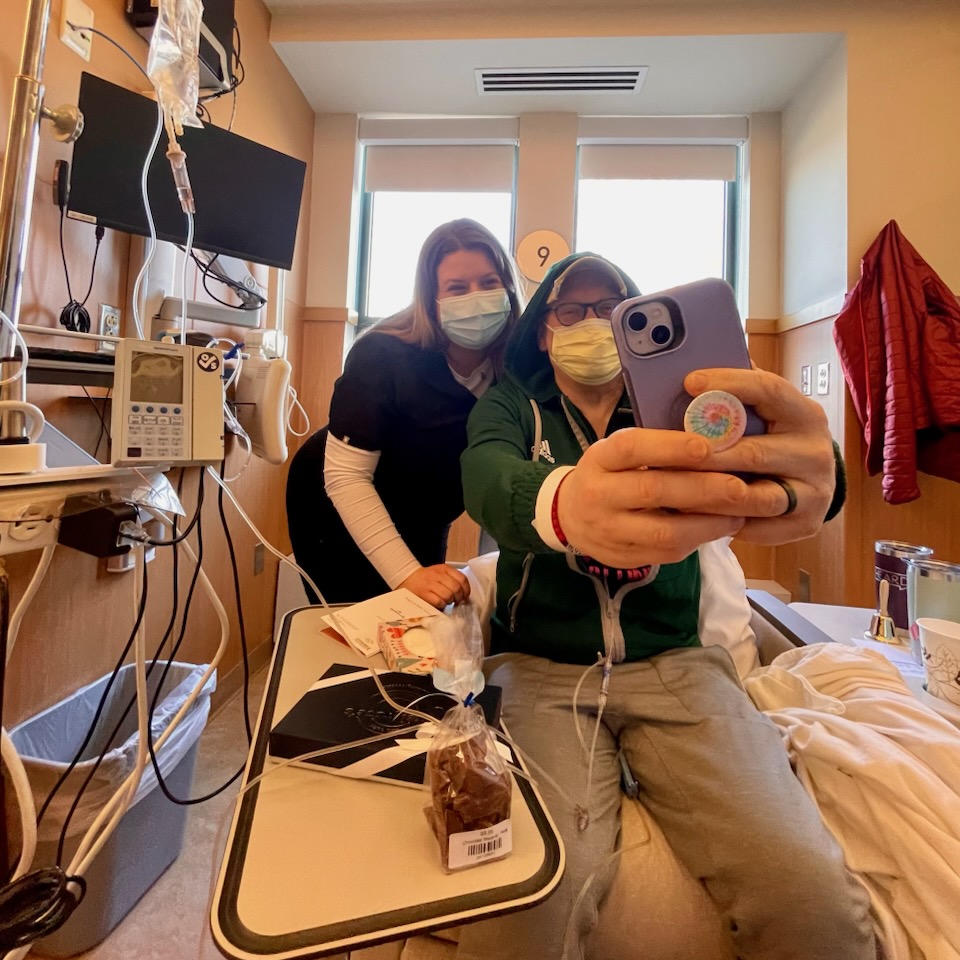
Jake Messier takin a selfie at his chemotherapy appointment.

Putting the MEN in KOMEN 

That mission is what’s driving Jake to walk in the Boston 3-Day this summer. With his team, Putting the MEN in KOMEN, he hopes to raise $10,000 and bring greater visibility to male breast cancer. 

“The Boston 3-Day is a big event,” he said. “If people see me, a man, holding a sign that says men can get breast cancer too, and they remember that—that matters and that is huge.” 

To register for the 3-Day, visit the3day.org. 

Statements and opinions expressed are those of the individual and do not express the views or opinions of Susan G. Komen. This information is being provided for educational purposes only and is not to be construed as medical advice. Persons with breast cancer should consult their health care provider with specific questions or concerns about their treatment.
 

Dennis’s Story of Survival and Service

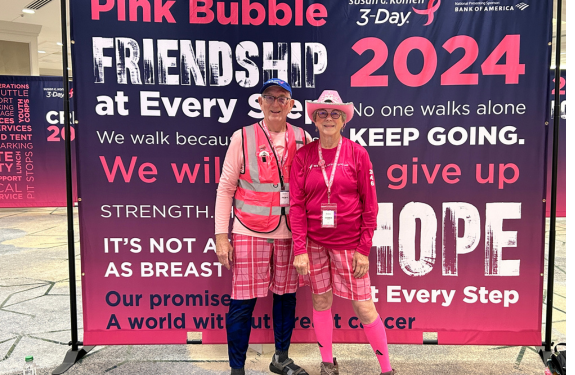
Dennis Siemsen at the 3-day

Dennis and his wife, Elaine, at the 2024 Susan G. Komen 3-Day.

When Dennis S. was 42, he faced something no husband or father expected: a breast cancer diagnosis. 

“I started noticing nipple discharge,” Dennis recalled. “That was in 1993, and it went on for almost two years before I did something about it. I was playing basketball a lot and when I’d take an elbow to the chest, they’d start to weep and wet my shirt.”  

His doctors initially thought the symptoms Dennis was experiencing might have been a hormonal issue and referred him to an endocrinologist. But when that was ruled out, Dennis was examined by another physician who discovered a lump and ordered a mammogram and then a biopsy.  

“At that time, my doctor was a young guy in his thirties. I was his first male breast cancer patient,” Dennis, now 74, said. “We were both shocked.”

Dennis underwent a mastectomy but was fortunate not to need chemotherapy or radiation. After surgery, Dennis chose to keep his diagnosis private.  

“I didn’t even tell my closest friends,” he said. “And I never took my shirt off at the pool. I’d say it was because I had red hair and burned easily. I think part of it was, if a woman saw me, I didn’t want my scar to make her feel uncomfortable.” 

Several years later Dennis’s wife, Elaine, connected with the Susan G. Komen 3-Day®. She was looking for a meaningful cause to support and signed up to walk in the Twin Cities. Dennis said he dropped her off at the 3-Day and picked her up when it was over. 

“After the walk, she was so excited and effusive,” Dennis said. “She told me about her experience and about the route safety guys on their bikes and motorcycles. She said, ‘You’ve got to join.’” 

An avid cyclist, Dennis was intrigued. He said he wasn’t sure how to get involved so he went out of his comfort zone.  

“It was hard to break into that group because they had their usual team of people. So, I decided to play the ‘survivor card’ and told them I was a breast cancer survivor. Well, that worked,” Dennis chuckled. “And they said, ‘We’d love to have you!’” 

That moment in 2012 was the start of Dennis’s connection to the 3-Day community. He still rides with the Route Safety team to help keep walkers safe, but this year he is taking time off to recover from two knee replacements. Dennis has found another way to support the 3-Day though. Since retiring, Dennis and Elaine spend the winters living in an RV resort in Arizona. Dennis offers free bike repairs to his neighbors and asks for donations to the 3-Day instead of payment.  

“For a long time, I hardly told anyone of my history with breast cancer. It wasn’t like I was embarrassed, I just thought no one needed to know,” Dennis said. “Now I share it because other men need to know that they can get breast cancer, too.” 


A First-Time Michigan 3-Day Walker Shares Her Dad’s Story

“As a kid and even now an adult, I think I’ve always seen my father as invincible; like nothing could stop him,” said Bridgette, a first-time Michigan 3-Day walker.  “He’s super handy and can fix just about anything around the house (although the joke in the family is that it might lean a little to left when’s done with it).  He’s hard working and always ready to lend a hand.  Even as an adult, he checks in on me as like I am still his little daughter.  I love my dad, and I know he loves me,” she said. That love is just one of the reasons she’ll be taking on the Michigan 3-Day this year; and the other is that Bridgette’s dad is a breast cancer survivor.

“It was a lucky cyst. That’s what the doctors told my dad.” In 2016, he had been having odd chest pain, and felt around his chest to find a lump. A biopsy confirmed it was benign, and that there was no cause for concern. Right before the procedure to drain the cyst, the doctors did one more scan – and this time, there was a new dark spot. A biopsy of this new dark area confirmed that he had breast cancer.

They scheduled a mastectomy of the left breast, but there was no radiation therapy and no chemotherapy. “One complete mastectomy of the left breast later, my dad is a survivor of breast cancer. But without the cyst, they would not have found the breast cancer so early.”

Bridgette had participated in a Komen 5k and donated to friends who were walking the 3-Day, but this year, she’s walking for the first time in Michigan. Bridgette knew men could get breast cancer, but she never knew of one who had. “However, since I’ve been raising funds for the 3-Day, I have learned of another male to have breast cancer (he also survived after a mastectomy).” Male breast cancer, while rare, is a reality. According to Komen.org, “In 2018, it’s estimated that among men in the U.S., there will be 2,550 new cases of invasive breast cancer (includes new cases of primary breast cancer, but not recurrences of original breast cancers).”

An active man, Bridgette’s dad works in the church as a lay leader, and helped to start the church’s food bank. He’s an Assistant Scoutmaster for the Boy Scouts, and an Advisor for his chapter of the Order of the Arrow. He loves sports and going to games, and is a Masonic lodge secretary. It’s safe to say Bridgette’s dad is always busy, and that survivorship was in his blood as a previous skin cancer and prostate cancer survivor, too.

But despite her dad’s now clean bill of health, Bridgette wants more justice in the fight against breast cancer. “What I can’t get out of my mind is that society begins to accept that losing a breast is normal,” she said.  “It’s NOT! It’s gone.  But so is part of your body.  My dad won’t go swimming without a shirt now.  He won’t even work around the house without a shirt on.  Breast cancer doesn’t just leave just a physical scar, it leaves an emotional one.  Not only do I hope to raise awareness by walking, I hopes the funds I raise will find a better cure than mastectomy,” she said.

As a working mom, a house fixer-upper, volunteer with the Jaycees and a treasurer of the Michigan JCI Senate, Bridgette also keeps busy, but follows her passion, “to make a difference – in the world or in someone’s life.” Bridgette, we’re pretty sure that just like your Dad, you will.

Help spread awareness of male breast cancer today. While it’s rare, it is real. For more resources on male breast cancer, visit Komen.org.