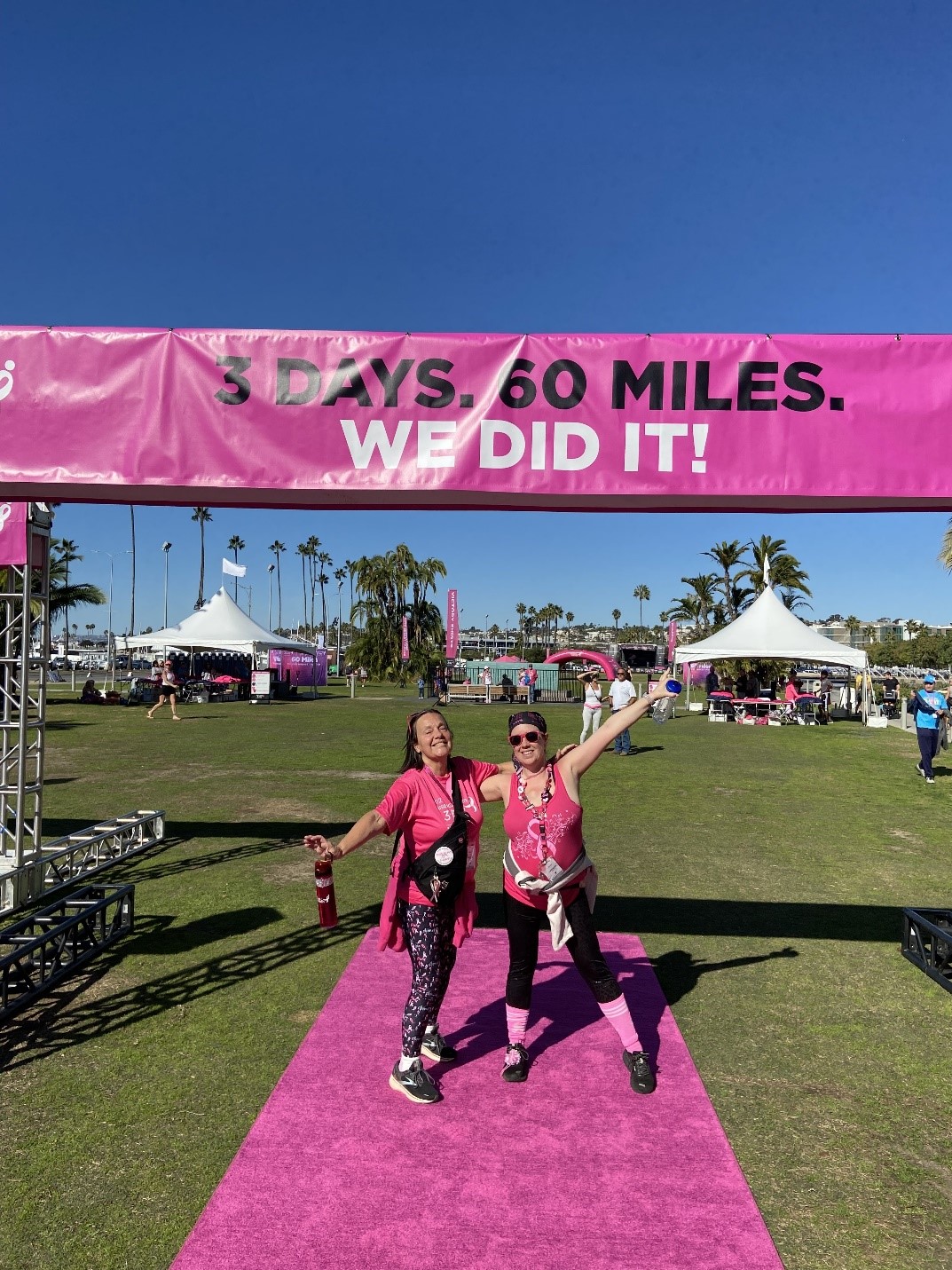
April Pink Bubble Story of the Month: Sherrylyn R.  

In 2019, Sherrylyn was 41 years old, her career was at an all-time high, and she and her partner were ready to expand their family. Eager to enter this new chapter of her life, she met with a fertility doctor who advised her to get testing done, including a mammogram. Thinking this was just another routine measure, one mammogram turned into another mammogram which led to a few ultrasounds, and eventually a mammogram biopsy. This resulted in Sherrylyn’s initial diagnosis of ADH deficiency, a hormone that regulates water balance in your body, with associated calcifications on her right breast. Her oncologist suggested an excisional biopsy, but with the holidays quickly approaching, she figured that ADH was nothing to get too worried about and scheduled the outpatient procedure for late January 2020. In the meantime, Sherrylyn’s doctor ordered an MRI for the excisional biopsy, ultimately revealing another growth on her right breast. What she originally thought was non-urgent turned into a diagnosis of stage 0 breast cancer with associated calcifications and ductal carcinoma in situ.  

With this new diagnosis, Sherrylyn’s January 2020 surgery for ADH was canceled, and she was instead scheduled to consult a geneticist for genetic testing and a plastic surgeon for reconstruction. The genetic testing was negative for the BRCA gene which frustrated Sherrylyn as she thought it would be easier to decide on a bilateral mastectomy if she had the BRCA gene. With the help of her oncologist, plastic surgeon, and the support from her family Sherrylyn decided on a bilateral mastectomy for peace of mind, and reconstruction to make her feel whole again. With efficiency in mind, Sherrylyn and her oncologist agreed to schedule the surgery for April 2020 before a 10-day vacation with her partner to ensure ample time off for rest and recovery. Though her doctor agreed on her chosen date for the procedure, they insisted she not wait any longer than that. They scheduled her April surgery consisting of a biopsy and lumpectomy on her right breast followed by radiation and an antihormonal endocrine treatment versus a bilateral mastectomy.  

We all know what happened in April 2020, as states shut down due to COVID-19. Sherrylyn was assured that her surgery would be performed as scheduled since it was essential, but she didn’t receive any other face-to-face time with her surgeons until the day of procedure. To make matters more complicated, her major surgery would now have to be outpatient to lessen any possible COVID-19 exposure in the hospital while recovering. She felt helpless, secluded, changed and unsure if she had made the right decisions. Some doubts would occasionally arise such as if any of her life choices would have prevented this or if she should have changed her priorities. Throughout recovery, Sherrylyn gained weight and was swollen for quite some time. To combat this, her surgeon suggested that she take more walks to heal faster and lessen swelling. With lockdown measures in full swing, she began walking around the neighborhood one block at a time until she found herself clocking three miles. She would spend this time discovering podcasts, listening to music, and searching for a community of breast cancer survivors. She eventually stumbled upon the Susan G. Komen 3-Day® and decided to commit as a 1-Day Walker in the 2021 San Diego 3-Day. 

With her avid walking schedule, Sherrylyn felt prepared and secure that even if she couldn’t do the full 20 miles in one day, she would still make a difference with fundraising and advance her physical progress. At her first Komen 3-Day, she lost one big toenail because of the hills and wrong shoe choice, but she felt revived. This encouraged her to walk all three days in Chicago 2022, but after the second day, she had many blisters and changed some practices along the route for Day 3. So, when a 2-Day Walker option was offered for the 2023 Denver 3-Day, she didn’t think twice. It was the city where her best friends live and since she works on the weekends, it was much more convenient to get two days off instead of three. With three 3-Days under her belt as a 1-Day, 2-Day and 3-Day Walker, Sherrylyn advises everyone to keep walking no matter how long or short each walk is. Know your body and listen to every ache and pain; it is not giving up if you must take a break or ask for help or a ride. As far as fundraising, don’t be shy to just ask people and share why it is important for you. Her favorite way to fundraise is to give people a card with a QR code to her fundraising account and to consistently remember why we raise this money. “Breast cancer has affected many like me. But unlike me not all of them have the financial means, resources or support to beat the disease. I also believe our donations fund organizations that lead change in government policies that affect healthcare and insurance” she shared. 

Each year has been a vastly different experience for Sherrylyn. In San Diego, she had a tremendous amount of fun since every street was full of support and her whole family and best friend’s family were there to meet her at the finish line. Chicago was special because of the walk along the lake, seeing Frank Gehry homes, having a walker stalker from her high school in the Philippines, and a couple of friends flew in as well. In Denver, she enjoyed walking through the beautiful neighborhoods and was supported by two of her friends from California who met with two Denver-based friends. Though each event is a different experience, it is the feelings of accomplishment and purpose that bring her back time and time again. It is a time for her to cry, laugh out loud, and reflect on the trials that she has faced brought on by breast cancer. Sherrylyn defines the Pink Bubble as “an aura of positivity from an unfortunate event that brought us together. The experience gives me space to reflect on the journey I’ve been on and the road ahead.” 

Sherrylyn looks forward to walking in the 2024 Dallas/Fort Worth 3-Day with an official team, For the Love of ChiChi. 

What it’s Like to Walk 1 or 2 Days at the Susan G. Komen 3-Day® 

Family obligations, coordinating days off from work, fundraising concerns, physical limitations… life comes with obstacles that may pose a challenge for some to walk 60 miles over three days. Fret not, because for the very first time at the Susan G. Komen 3-Day® you have the option to walk one, two, or three days in each city! Regardless of your schedule or abilities, you can now become fully immersed in the Pink Bubble in a way that works best for you. You’ve heard stories from our Komen 3-Day Walkers, so we’ve teamed up with Elissa R. and Jenn H., 1-Day and 2-Day Walkers from the 2023 Denver 3-Day, to share what it’s like to be part of the 3-Day® for 20 or 40 miles. If you haven’t registered yet or are considering adding another city to your 2024 3-Day itinerary, these women are here to help you decide which option is best for you.  

1-Day Walker: Elissa R.  

Breast cancer survivor Elissa R. first participated in the 3-Day in 2018 alongside her sisters in San Diego and has walked five times since, celebrating her 20-year survivorship at the 2023 Denver 3-Day. Elissa walked all three days in 2018 then switched to walking one day in 2019 due to her walking partner’s physical limitations. Every year, they arrive early to cheer the walkers on the first or second day and do some exploring before embarking on their 20-mile journey. Though she’s not walking all three days, she still feels the power of the Pink Bubble whenever she joins the 3-Day. She describes it as a sisterhood of people who want to end breast cancer, where everyone knows someone who’s been impacted or has fought it themselves. The most powerful moment she remembers was the 2021 Closing Ceremony where she walked hand-in-hand with other survivors surrounded by a sea of supporters.  

She is looking forward to walking in the New England 3-Day this year as a 2-Day Walker, an option that allows her a bit more flexibility and time within the Pink Bubble. In the meantime, she walks each day sporting her 3-Day attire which often sparks conversation amongst strangers to share their breast cancer experience, learn about the 3-Day, or inquire about donating.   

2-Day Walker: Jenn H. 

Jenn is a three-time 3-Day Walker who began her journey at the 2018 Philadelphia 3-Day alongside her sister. Having dense breast tissue and a family history of cancer, she walks the 3-Day while she is a healthy individual to make an impact and hopefully create a day where cancer isn’t such a debilitating diagnosis. In 2023, she chose to walk two days in Denver because it was just a short drive from her hometown in Nebraska and was unsure if she would be able to meet the fundraising requirements. Still eager to push herself, Jenn and her sister both decided to shoot for the middle of the road as 2-Day Walkers. Not only did they feel that it was the most flexible option, but it still granted them the opportunity to meet new people, hear their stories, have fun with the crew, and make an impact.  

In 2024, Jenn, her sister, niece, and friend all are embarking on the Denver 3-Day as 3-Day Walkers to continue making an even greater impact. They walk to help offset any of the costs for the people who are already struggling to stay healthy and pay their regular bills while undergoing treatment. “People shouldn’t have to choose between paying their bills and getting the treatment and support they need to get better,” she shared. To anybody considering the 3-Day, Jenn provides wise words of encouragement. “It will be the best, hardest thing you’ll do. It’s hard fundraising, hard training, hard getting used to the idea of 60 miles in three days, but it’s the best time and the most fun, hard thing I have done. AND… it’s not harder than cancer.” 

Will you be walking one, two, or three days at the 2024 3-Day? 

A Guide to the Route: Pit Stop vs Grab & Go 

The Susan G. Komen 3-Day® is filled with experiences and information that may seem foreign to first-time participants or even veterans. To ensure that you show up to the event as prepared as possible, we’re kicking off A Guide to the Route, a three-part series giving you a behind-the-scenes glance at what you’ll see while inside the Pink Bubble. Today we’ll be covering the differences between a pit stop and a grab & go. Future posts will talk about sweep vans and ceremonies, providing insightful information from those who create the event from the ground up. 

When you arrive at the Komen 3-Day you’ll be handed a route card each day which provides information regarding the day’s mileage and schedule. You’ll probably notice a plethora of pit stops and the occasional grab & go along the route and may wonder exactly what these are. While similar in their purpose to provide you with a place to rest and fuel up, there is a difference between the two types of stops. It’s important to know what makes these two route stops unique, so that when you begin each day of the 3-Day®, you can plan accordingly and in a way that will help you safely reach the finish line. To ensure that you’re successful along the route, we’ve gone ahead and noted all the frequently asked questions and misconceptions about pit stops vs grab & gos.  

What is a pit stop? 

A pit stop is a rest opportunity for walkers that occurs every 3–4 miles as allowed. Pit stops have snacks, drinks, portable toilets and medical. They are a chance for walkers to take a load off, refresh their water bottles or seek medical attention if necessary. 

What is a grab & go? 

A grab & go is a mini rest stop and is used to fill in gaps in mileage where a pit stop either doesn’t fit or where there is too much mileage between stops. A grab and go only offers drinks and portable toilets for walkers. A grab & go does not have snacks or medical services. 

What are the similarities and differences between the two? 

Like a pit stop, a grab and go has a scheduled opening and closing time to ensure participants keep on pace. Both are staffed with wonderful crew who are ready to add a little pep and energy back into your step. 

While both are available to all walkers, ONLY a pit stop has medical crew present and is staffed to help ALL walkers. Without Medical onsite at a grab & go, walkers who need medical help are brought to the next available pit stop. Sweep vans, vehicles that pick up participants along the route and bring them to the next stop, do NOT drop or pick up from a grab & go (except in extreme situations). 

When can a walker expect to see a pit stop vs. a grab & go? 

Pit stops are approximately every 3–4 miles. A grab & go is used to fill in gaps when mileage between pit stops is more than four miles, to help whenever participants are bussed out to the route, or whenever a site is not large enough for a pit stop. 

How many grab & gos are on the route each day? 

The number will vary depending on the needs of the route each day. Typically, there is one grab & go each day but sometimes there are none and in very rare cases there are two. 

What are the need-to-knows when planning your day along the route?  

Since your safety is of our utmost importance, sweep vans are NOT allowed to drop off participants at grab & go locations as the onsite crew is not equipped to assist walkers in need. A grab & go is staffed with a smaller crew than a pit stop and it does not have the resources or space for medical crew or to provide sweep van access. If after arriving at a grab & go you decide that you need to utilize a sweep van, you will need to walk out on the route and signal for a sweep van like you typically would. 

If you have any more questions regarding pit stops vs grab & gos, please contact your 3-Day coach for more information. Happy walking!