A Salute to the 3-Day Medical Crew

Today is National Nurse’s Day, and we are honored to have many accomplished nurses as part of our 3-Day Medical Crew. Along with doctors, physician’s assistants and other medical professionals, these nurses keep all our 3-Day participants safe and healthy during the 3-Day weekend.

To celebrate them, and nurses across the country, we had a few of our 3-Day Medical Crew Captains share their 3-Day stories.

Barb Diamond Johnson, Medical Captain at the Seattle and Dallas/Fort Worth 3-Days

My commitment to the 3-Day and our local Komen affiliate is thanks to the care my mom received when her insurance fell short. Her care was funded by Susan G. Komen. I initially did the 3-Day in 2007 as a way to pay that back. My intention was to be one and done. But I’m still here…haha! My husband, two daughters, and son-in-law all now participate, too. I even met my current three best friends through the 3-Day.

I have so many amazing memories from my time on the 3-Day…

Years ago, my grandmother lived in Oregon. She used to help take care of the “neighbor girl.” I was in college at this point. I don’t ever remember hearing the neighbor girl’s name. My 1st year in Seattle, (Medical Lead) Jason Page assigned a social worker to my crew. I felt very drawn to her and would continue to have dinner with her when I would come to Seattle to visit my oldest daughter. Later while visiting with her, someone asked where she grew up. She mentioned the town where my grandparents lived. Lo and behold, she is that same neighbor girl! I had quite an ugly cry at that moment. We both now have bracelets that say “Gramma Glady’s Girls.”

Then, another year, we had a participant with Stage IV breast cancer whose family had been pushing her through the event. She would nap at lunch on our cots. Dr. Jim Lummus pushed her from Pit Stop 4 into the Participant Finish Area. We all were affected and inspired by her courage.

I have so many funny memories, and even a few moments of intense emotion, all from the 3-Day.

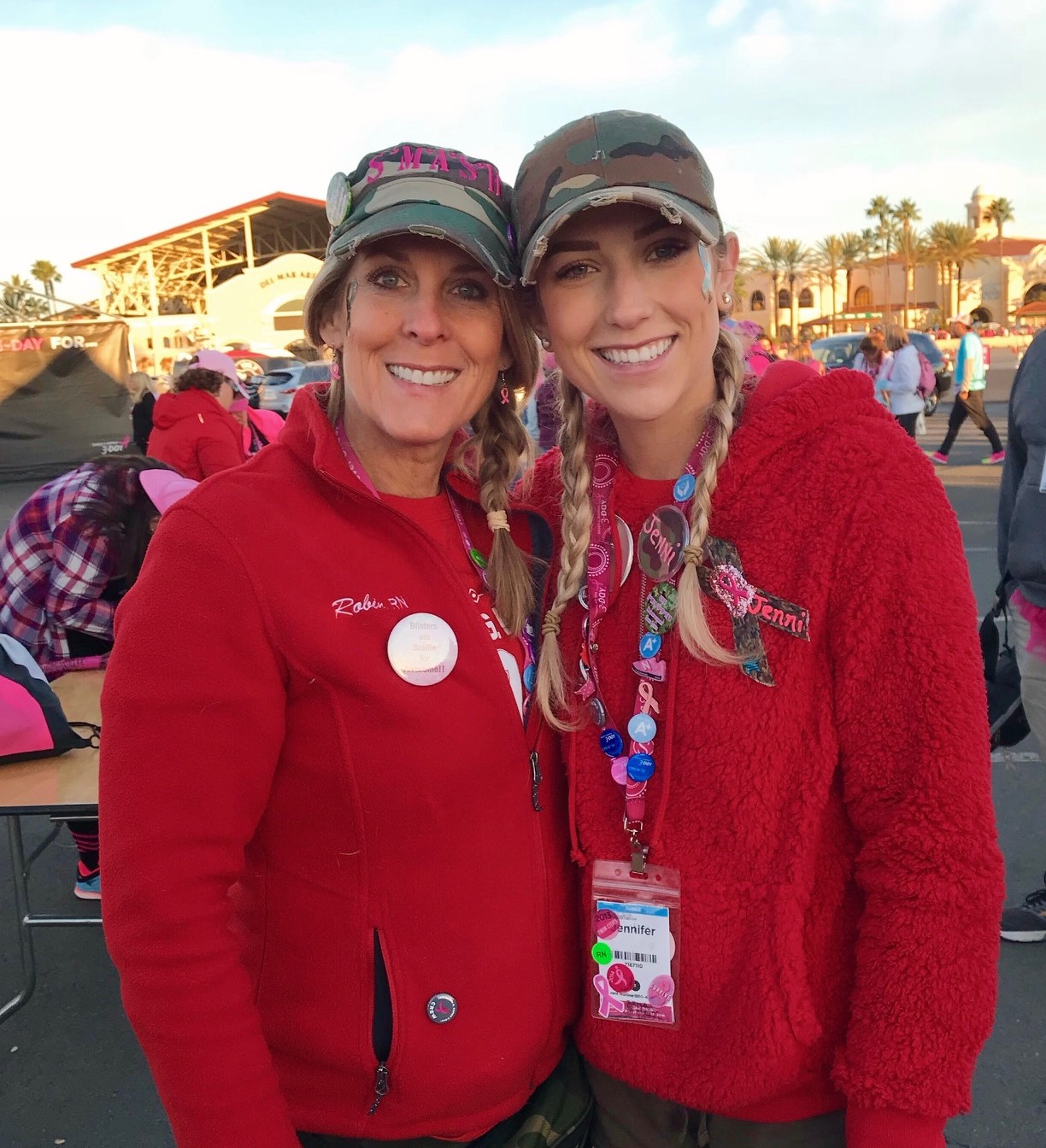
Robin Knapmiller, Medical Team Captain at the Twin Cities and San Diego 3-Days

It’s hard to express in words the love and appreciation I have for my Medical Team, but I’d like to take a moment to recognize them and thank them for all they do. They have shown over and over the ability to work with complete strangers in a new environment, and to do so with love and compassion, what a gift! I truly believe the personal connection makes a difference in the lives of the walkers. I have seen over and over how they not only treat the blisters and illnesses…but really get to know the walkers by name, share in their stories, meet their families and cry both happy and sad tears together! Sending love and thanks to ALL the3Day Medical Crew. You truly are THE BEST!

I am so honored to be among you, and to have my family at my side too! My daughter Jenni grew up watching me work the event, but since there was not a Youth Corps then, she had to wait until she was older to help. In 2013, Jenni got her Nursing Degree and we could finally work the events together. We haven’t missed a year since!  
Do you have a member of the medical crew who you would like to salute? Are you a medical crew member with a memory from the 3-Day to share? Tell us in the comments! We are honored to have so many talented medical professionals keeping us safe all weekend long.

For more stories about our 3-Day Medical Crew, you can check out these blog posts:

Healthy Living: Preparing you Mind, Body and Bones for the 3-Day

Thanks to the support of Amgen and working in partnership with American Bone Health, we are excited to provide you with a special series of emails, blogs and additional resources that will help prepare you for this life-changing event, as well as year-round health.

It Takes More Than a Number to Prevent Bone Loss and Fractures

Special Guest Contributor: Risa Kagan, MD, FACOG, CCD, NCMP

I have been working in the bone world for many years. I know it’s challenging for people to keep up with the emerging science and research, so here is a look at where we came from and where we are now.

Advances in medicine over the past several decades have helped us live longer, and because many women previously didn’t live long past menopause, we didn’t know the impact of the loss of estrogen on bone mass.

In the 1980s, bone density testing machines gave us the ability to identify the quantity of bone mass and monitor changes in the trabecular structure of bone. This is when we started using the terms “osteoporosis” and “osteopenia.” In 1994, the World Health Organization (WHO) established a definition of osteoporosis based on the statistical concept of a normal distribution. A consensus of scientists determined that a T-score — which is a standard deviation from the average 30-year-old — of more than 2.5 standard deviations below the mean should be defined as “osteoporosis.” “Osteopenia” became the standard term for a T-score between -1.0 and -2.5. Osteopenia is not a disease, but a term created by the WHO to describe low bone mass. Anyone with a T-score greater than -1.0 was consider “normal.”

It’s not perfect, but it’s a start.

One of the main reasons this isn’t perfect is because scientists didn’t do a bone density test on a person when they reached peak bone mass at age 30. So, it’s not clear whether a T-score at age 50 was the result of bone loss. It could have been the peak bone mass/density they ever achieved.

As the science has improved, we have learned to focus on bone quality as well as density. The quality of the bone is important in understanding fracture risk. Just like high cholesterol is a risk factor for heart attacks and high blood pressure is a risk factor for stroke, osteoporosis on a bone density test is a risk factor for fracture. We think of fractures as “bone attacks” and are now developing treatment that focus on fracture prevention, rather than just bone density. As a result, we realized not all people were candidates for osteoporosis medicines, especially women and men who are relatively young, without any risk factors for breaking a bone.

Having a better understanding of bone quality is encouraging us to engage in more conversations with patients about fracture risk. We use calculators to understand individual’s risk and their chances of breaking a bone. This helps us focus on a bone health plan that is appropriate for an individual.

You have an important role to play in this discussion. Knowing your risks and taking action by talking with your doctor to prevent bone loss can help you avoid a “bone attack.”

Not all people will have the luxury of prevention strategies alone. Whether it’s a medical condition, a medicine you take, or a family history of bone loss and fractures, you could be someone who benefits from a medication to reduce the risk of a “bone attack.” 

All the medications used for the prevention and treatment of osteoporosis have good safety data, and they reduce the risk of fractures – especially spine and hip fractures. We know that up to 25 percent of people with hip fracture die within a year and most others are not able to have mobility without assistance. We know now how to determine who is a good candidate for treatment based on fracture risk and what medicine would be best.

In December 2017, a study using the Medicare data found the decline in hip fractures had leveled off. The researchers estimated 11,464 additional hip fractures (costing $459 million) occurred from 2013-2015 due in part to a decline in screening and treatment and an increase in other chronic conditions, like diabetes. We are now facing a public health crisis in our older population.

Let’s remember that knowing our risk factors and our bone density scores is just the start. Doctors and patients need to work together to take action and prevent bone loss and fractures. 

About Dr. Kagan

Dr. Kagan is a board-certified obstetrician-gynecologist and Clinical Professor in the Department of Obstetrics, Gynecology, and Reproductive Sciences at the University of California, San Francisco. She serves on the Medical and Scientific Advisory Board of American Bone Health (FORE) and is the principal investigator on numerous women’s health clinical research studies. Dr. Kagan is well known as a communicator and teacher and is often approached by media and public forums for her expertise and frequently an invited speaker at national and international scientific meetings.